Showing posts with label evolution. Show all posts

June 10, 2012

Sexual Selection in Butterflies


Sexual selection is a natural selection among organisms in which specific genetic traits are preferred for reproduction. Sexual selection is special because it may cause domination of a desired trait like colorful feathers on a peacock, wings on a butterfly or even loud roars in lions.

There are two mechanisms of sexual selection: intersexual and intrasexual.
Intrasexual Selection involves characteristics which affect the outcome of competition among members of one sex for access to members of the other sex.
Intersexual Selection would influence the evolution of secondary sexual characteristics which determine the relative "attractiveness" of members of one sex to the other sex.

In this case, the developmental evolution of wing patterns lead to the diversification of butterfly species which intersexually, allows them to become more attractive when it comes to mating.


June 2, 2012

Sexual selection in Peacocks

Before

After

I decided to model sexual selection as a evolutionary process for my model.  I modeled the process by drawing the peacock before and after the evolutionary process took place. Before the evolutionary effect, the peacock had white feathers and after the process it had vibrant green and blue feathers. The white feathers were too bright for the peacocks and white peacocks were easily spotted by predators, therefore, many males would chose the colorful peacock over the white because they were more appealing. This made sexual selection a selective process as opposed to random since the males had to chose which female they would want to mate with.

May 29, 2012

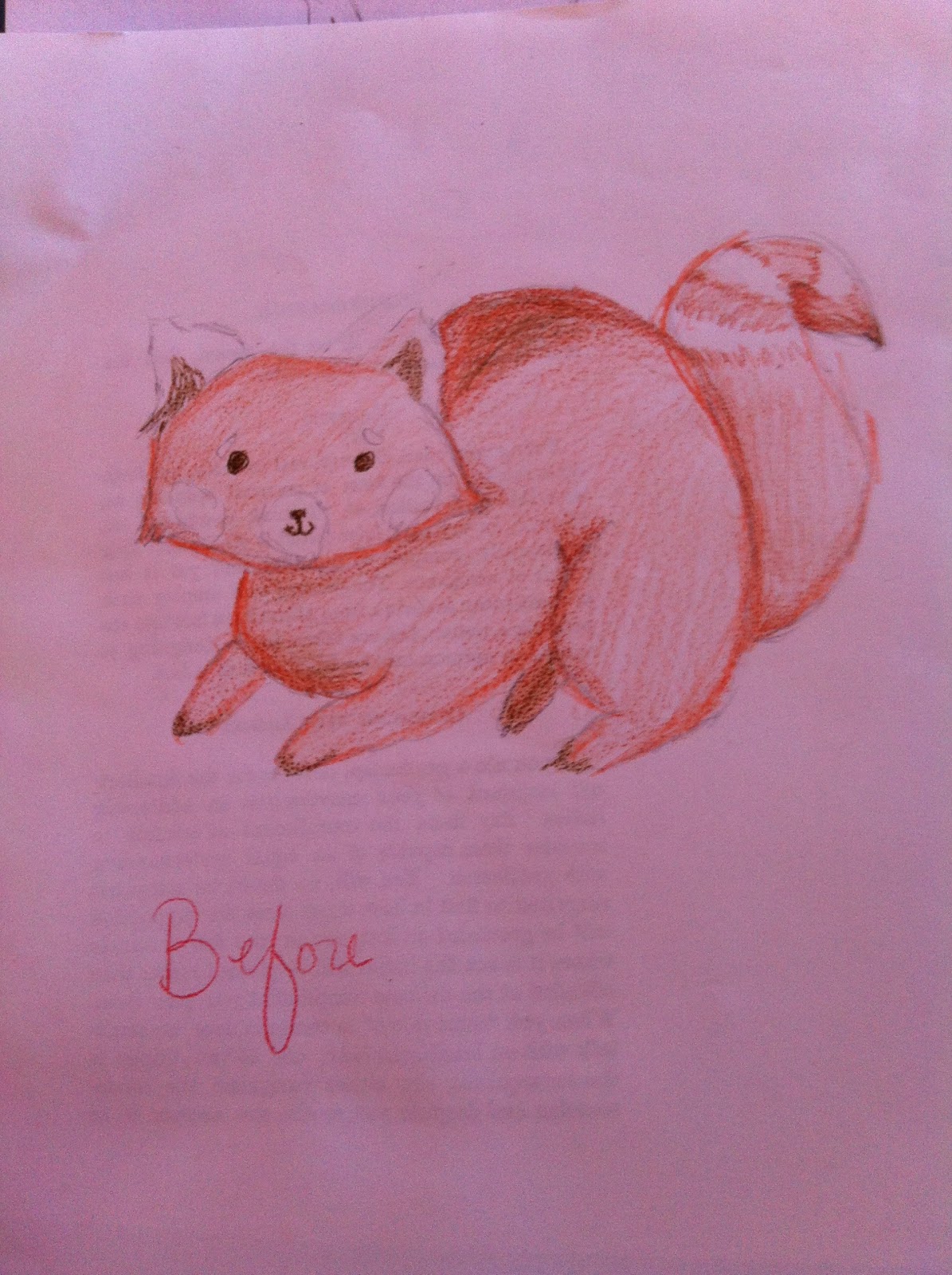
Natural Selection in Red Pandas

Before

After

My model shows is an example of natural selection in red pandas. Red pandas hunt during the night as nocturnal carnivores. In the before picture, the panda has smaller ears and eyes. As a result of natural selection, the more adapted panda has bigger eyes and ears. This way, they are more successful at hunting at night. The big eyes make it easier to see their living prey. The larger ears will make it easier to hear during the night time and not get eaten. Natural selection is the biological process of survival of the fittest. Those who are most well adapted to the environment will survive to reproduce and pass down the wanted traits. According to Darwin, natural selection needs four things: variation, inheritance, high rate of population growth, and  Differential survival and reproduction. Natural selection is one of the basic mechanisms of evolution.

May 28, 2012


The evolutionary process that is being modeled is natural selection.  As time went on, the beaks on finches changed significantly.  Although only two other types of beaks are shown here, a plethora of different beak sizes became present.  The initial beak made it difficult for the finches to exploit multiple food sources, but over time different beak sizes were able to thrive in different environments.  I chose this evolutionary process to model because I was inspired by the Galapagos Island presentation that I attended at Hofstra University.  The bigger beak allowed for the exploitation of other dietary supplements while the smaller beaks allowed the finches to obtain food in smaller spaces.  The evolution was able to occur because finches that were able to survive reproduced.  The finches that were inadequate at obtaining food were not able to survive and pass their traits on.  The cause for the variation in finch beak sizes all originates from the fact that there was competition for food and some beaks were advantageous to have while others were not.  

Natural Selection in Beetles


I am modeling the evolutionary process of natural selection on a beetle population. I showed it by before natural selection and after the process was complete. You can see how there was variation in color of beetles before natural selection and after only the brown survived long enough to reproduce. Since the green beetles were eaten more by birds more brown beetles reproduced. After generations only brown traits are passed down, because those are the only ones to survive and become more common. The mode of evolution is selective due to predators. In this case the environment didn’t help the green beetles camouflage, causing them to be eaten and spotted more than the brown beetles were. Eventually the process will go on long enough to only reproduce brown surviving beetles.

Natural Selection In Hummingbirds


The evolutionary process that is modeled above is natural selection.  As time went on the beak of the hummingbird changed.  Before the change the hummingbird's beak was very fat.  This made it hard for the hummingbird to get food from the flowers.  As time continued the birds beak began to get thinner in order for it to get its food.  I chose this evolutionary process to model because the environment wasn’t able to provide for the hummingbirds with fat beaks, so in order to survive better they adapted to their environment and over time their beaks got thinner.  The thinner beaks let them get the nectar from the flower easier. This change occurred by the hummingbirds with the thinner beaks surviving better than the ones with the fatter beaks. This evolution is selective, but not random because the birds passed on the trait for a thinner beak. This change did not occur very fast, it happened over a long period of time. The source of variation is that the hummingbirds with fat beaks weren't able to compete and survive as well as the hummingbirds with thinner beaks were.

Natural Selection


My model depicts a prime example of natural selection.  The example deals with English peppered moths which come in two different colors: a light shade and a dark shade.  In England prior to being industrialized, the moths with the light shade were better adapted to the environment because they were more adept at camouflaging in order to hide from predators.  This made for a larger population of the light shaded peppered moths.  Once England became industrialized and numerous factories were built there was a lot of pollution in the air.  The factories mainly ran on coal which produced a thick black smoke.  The smoke inevitably reached and settled on the plant life making the trees considerably darker.  The dark trees made the light shaded moths visible, and more prone to predation; allowing for the dark shaded moths to survive and reproduce.  Ultimately there was a greater population of dark shaded moths than light shaded moths.  Natural selection allows more the more fit member of a species at the given time reproduce at a higher rate, due to less predation or the ability to easily obtain resources, which increases the frequency of the given trait that makes that member more fit.

Natural Selection In Giraffes

I chose to model the evolutionary process of natural selection and how it affected giraffes.  I chose to model it by showing the changes before and after of the giraffe due to the natural selection. I chose to represent it in this way because you can easily and clearly see the drastic change that occurred in the giraffe, from short neck to long neck. Natural selection though didn't make this change suddenly, the length of the giraffes necks increased in increments over time through evolution and eventually increased to the current long neck size. The reason for this evolutionary process as shown above in the picture is because the short neck giraffes couldn't reach the leaves in the trees and therefore couldn't survive. This evolution is selective because only the giraffes that had longer necks were able to successfully compete, and then be able to reproduce with other long neck giraffes, and thus producing offspring with more long necks, and fewer with short necks. This isn't random evolution because only the long neck giraffes would survive so they would be the only ones reproducing and making more long neck giraffes, because that is the favorable trait in their environment. The source of variation that lead to the evolution was that there were giraffes in the same area that had shorter and longer necks, and the ones with longer necks were able to reach the trees to eat and survive, so the ones with the shorter necks couldn't compete as well and therefore wouldn't reproduce to create more short necks.