Showing posts with label natural selection. Show all posts

May 29, 2012

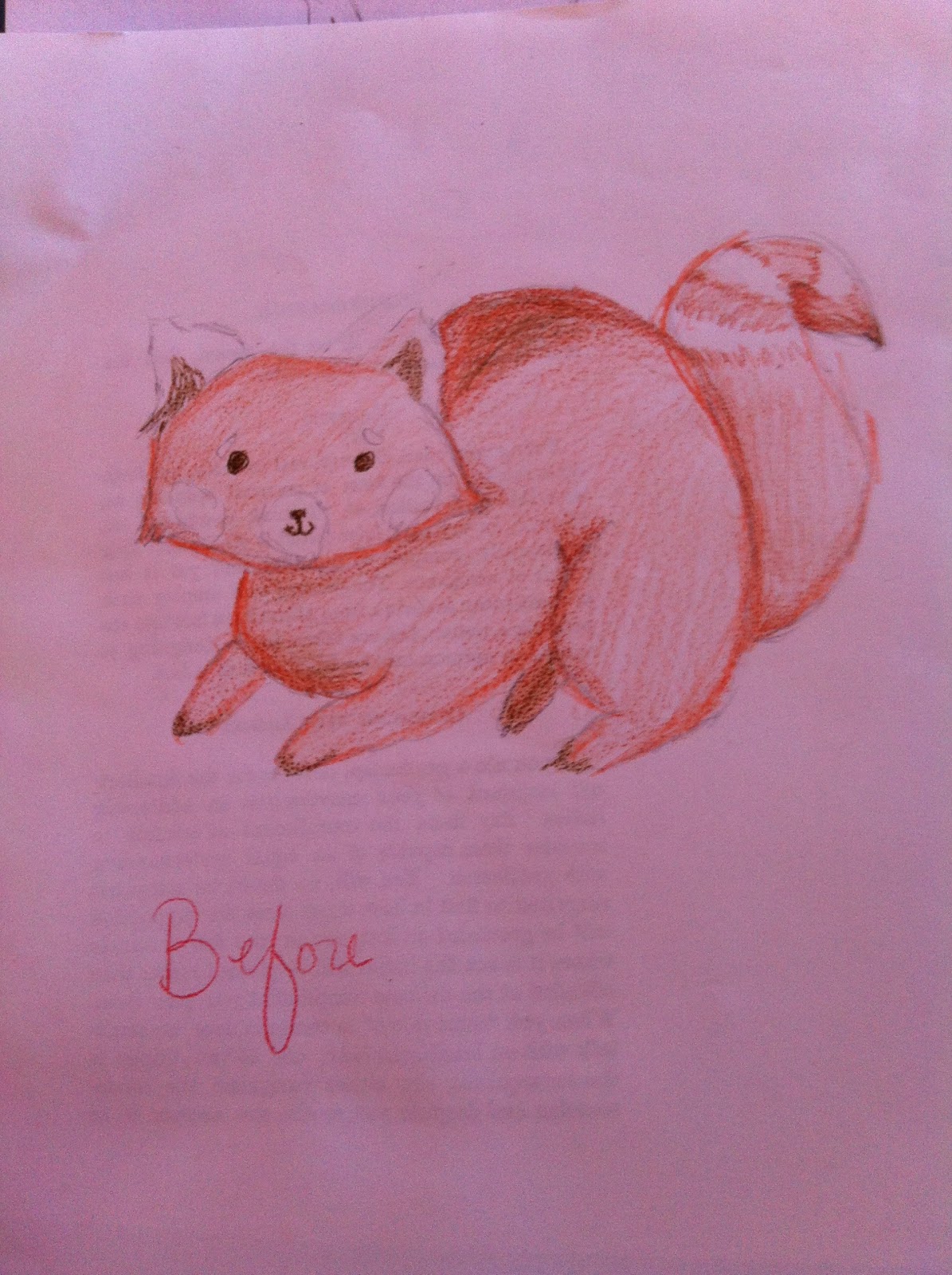
Natural Selection in Red Pandas

Before

After

My model shows is an example of natural selection in red pandas. Red pandas hunt during the night as nocturnal carnivores. In the before picture, the panda has smaller ears and eyes. As a result of natural selection, the more adapted panda has bigger eyes and ears. This way, they are more successful at hunting at night. The big eyes make it easier to see their living prey. The larger ears will make it easier to hear during the night time and not get eaten. Natural selection is the biological process of survival of the fittest. Those who are most well adapted to the environment will survive to reproduce and pass down the wanted traits. According to Darwin, natural selection needs four things: variation, inheritance, high rate of population growth, and  Differential survival and reproduction. Natural selection is one of the basic mechanisms of evolution.

May 28, 2012

Natural Selection in Beetles


I am modeling the evolutionary process of natural selection on a beetle population. I showed it by before natural selection and after the process was complete. You can see how there was variation in color of beetles before natural selection and after only the brown survived long enough to reproduce. Since the green beetles were eaten more by birds more brown beetles reproduced. After generations only brown traits are passed down, because those are the only ones to survive and become more common. The mode of evolution is selective due to predators. In this case the environment didn’t help the green beetles camouflage, causing them to be eaten and spotted more than the brown beetles were. Eventually the process will go on long enough to only reproduce brown surviving beetles.

Natural Selection In Hummingbirds


The evolutionary process that is modeled above is natural selection.  As time went on the beak of the hummingbird changed.  Before the change the hummingbird's beak was very fat.  This made it hard for the hummingbird to get food from the flowers.  As time continued the birds beak began to get thinner in order for it to get its food.  I chose this evolutionary process to model because the environment wasn’t able to provide for the hummingbirds with fat beaks, so in order to survive better they adapted to their environment and over time their beaks got thinner.  The thinner beaks let them get the nectar from the flower easier. This change occurred by the hummingbirds with the thinner beaks surviving better than the ones with the fatter beaks. This evolution is selective, but not random because the birds passed on the trait for a thinner beak. This change did not occur very fast, it happened over a long period of time. The source of variation is that the hummingbirds with fat beaks weren't able to compete and survive as well as the hummingbirds with thinner beaks were.

Natural Selection


My model depicts a prime example of natural selection.  The example deals with English peppered moths which come in two different colors: a light shade and a dark shade.  In England prior to being industrialized, the moths with the light shade were better adapted to the environment because they were more adept at camouflaging in order to hide from predators.  This made for a larger population of the light shaded peppered moths.  Once England became industrialized and numerous factories were built there was a lot of pollution in the air.  The factories mainly ran on coal which produced a thick black smoke.  The smoke inevitably reached and settled on the plant life making the trees considerably darker.  The dark trees made the light shaded moths visible, and more prone to predation; allowing for the dark shaded moths to survive and reproduce.  Ultimately there was a greater population of dark shaded moths than light shaded moths.  Natural selection allows more the more fit member of a species at the given time reproduce at a higher rate, due to less predation or the ability to easily obtain resources, which increases the frequency of the given trait that makes that member more fit.

Natural Selection In Giraffes

I chose to model the evolutionary process of natural selection and how it affected giraffes.  I chose to model it by showing the changes before and after of the giraffe due to the natural selection. I chose to represent it in this way because you can easily and clearly see the drastic change that occurred in the giraffe, from short neck to long neck. Natural selection though didn't make this change suddenly, the length of the giraffes necks increased in increments over time through evolution and eventually increased to the current long neck size. The reason for this evolutionary process as shown above in the picture is because the short neck giraffes couldn't reach the leaves in the trees and therefore couldn't survive. This evolution is selective because only the giraffes that had longer necks were able to successfully compete, and then be able to reproduce with other long neck giraffes, and thus producing offspring with more long necks, and fewer with short necks. This isn't random evolution because only the long neck giraffes would survive so they would be the only ones reproducing and making more long neck giraffes, because that is the favorable trait in their environment. The source of variation that lead to the evolution was that there were giraffes in the same area that had shorter and longer necks, and the ones with longer necks were able to reach the trees to eat and survive, so the ones with the shorter necks couldn't compete as well and therefore wouldn't reproduce to create more short necks.


Natural Selection in Sharks


My model shows the evolutionary process of natural selection in a shark population.  I drew pictures of the shark population before and after natural selection occurred.  I chose to represent natural selection in this way because it shows how the colors of the sharks changed due to natural selection.  The change in color of the sharks was due to predators.  The gray color of the starting population was visible to the predators in the dark blue oceans.  As time passed, their color patterns changed.  The topside of the sharks turned into a dark blue or gray color that allows them to blend in with the sea.  Their bellies turned into a white color that protects them from predators below them.  When the predators look up, the sharks' bellies blend in with the bright colored surface water due to the sunlight.  This mode of evolution is selective, rather than random.  Only the sharks with the new color pattern would be able to camouflage and survive from the predators.  Other species of animals have also adapted to be able to camouflage in their environments.  Escaping from predators is the main source of this evolution.  Sharks that are better blended in the sea will be able to have a  higher successful hunting rate.


"Platypus" Natural Selection

The evolutionary process shown is natural selection. I used colored pencils and paper to draw the changes after natural selection. I chose to represent natural selection in this way because it shows a clear picture of how the population of “platypus” changed. What led to this change is a lack of food source. All of the food that was originally being consumed by the “platypus” was nearly gone and another food source was needed for survival. The only other food source was a crustacean that lived in small niches in rocks. The “platypus” with the sharper beaks were able to access this new food source, while the others were not. This is a selective mode of evolution; only the “platypus” with sharper beaks survived to reproduce. This is not random evolution. Ducks and other birds have had pointed beaks to help them access food. This characteristic is the source of variation in the “platypus” beak.